
Event Registration
Set up an Event Registration through our surveys feature. Send out invites to all of your contacts for webinars, client appreciation events, and more!
Creating an Event Registration
You can access Surveys, including Event Registration, through the menu in the upper right corner or through the navigation bar menu on the left of the Levitate dashboard

From there, you'll enter the Events tab and choose Create Event Survey
Once on your blank new template, you'll be able to add the name of the event, the date and time, a location, and details.

The Details editor toolbar includes a Clear formatting button (the Tx icon) after the link button. Select the text you want to clean up, or use Select all, and click the button to remove pasted fonts, sizes, colors, and other styling. Links are kept. The button works on the selected text only.
All-Day Events
An event can run all day instead of at a set time. In the event editor, open the date picker and tick the All day checkbox below the calendar. Ticking it hides the start and end time pickers, and you don't need to enter a time. Anyone who can create or edit events can use it.
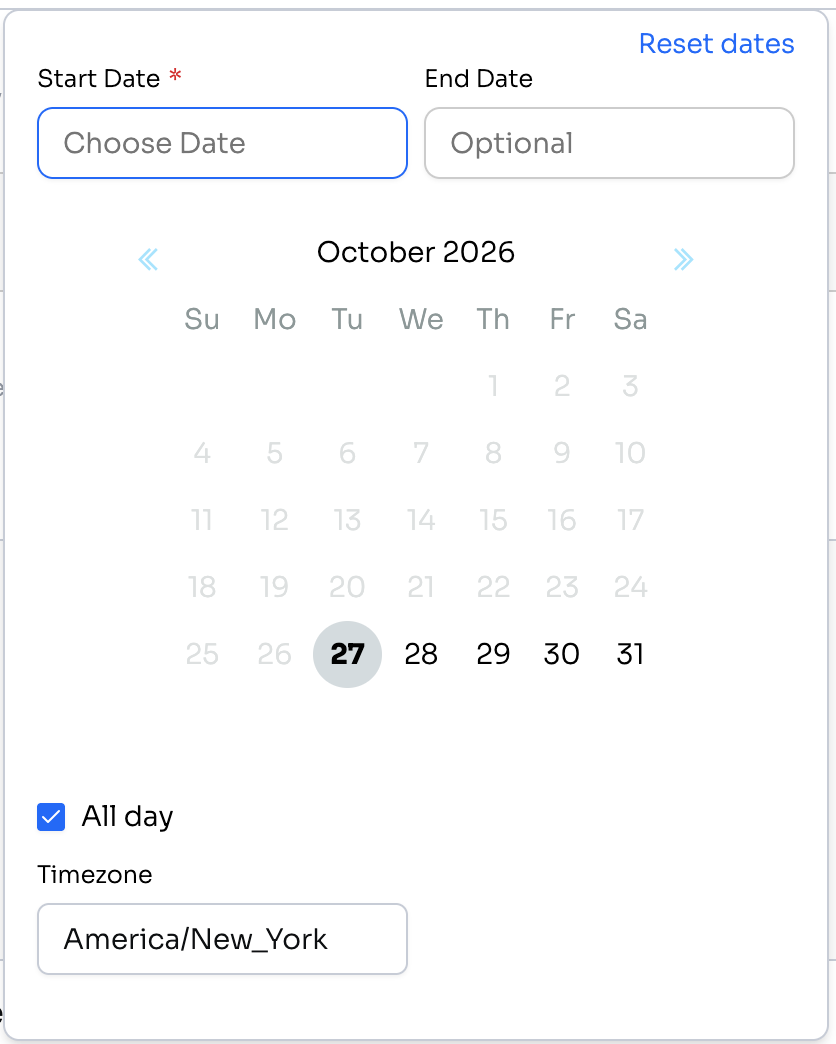
An all-day event can be a single day or span several days. It runs from the start of the first day through the end of the last day, in the event's time zone. When you reopen an all-day event to edit it, All day is still ticked. Clear the checkbox to go back to a start and end time.
All-day events show the date followed by "All day" instead of a time, for example "Nov 3rd, 2026 · All day". Multi-day events show a date range. This appears in these places:
- The preview in the event editor.
- The public registration page.
- The event cards on the Events Landing Page.
All-day events also appear in these places:
- The in-app calendar shows an all-day event in the all-day row.
- Event search results show the day instead of 12:00 am.
- The Add to Calendar links for Google, Outlook, Outlook365, and Yahoo create all-day entries.
- Registration confirmation emails and their calendar files show "All day".
Note: An event's end must be after its start. Levitate rejects an event whose end is not after its start when you create it. When you edit an existing event, the check applies only if you change the dates.
Show Form Name
By default, the form name is displayed at the top of the registration form that invitees see. To hide it, open the event registration form settings and toggle off Show Survey Name. Turn it back on at any time to display the form name again.

You can upload your own image, generate one with AI, or browse our free image library to show on the event page your invitees see.

The image picker also includes a My Images tab, which gives you access to images saved in your account's Image Library. If you have previously uploaded images to the Image Library, you can select them directly from this tab — no need to re-upload. This is the same Image Library available in the blog, newsletter, and email editors.
Under Attendees, you're able to modify RSVP settings— you can make an RSVP request, require a phone number to be provided when RSVPing, set a maximum number of 'plus ones' a guest can add, set a maximum capacity for the event itself, and set a cutoff date for RSVPs
Attendees settings also include an Include Check-In QR Code toggle, on by default, that controls whether the confirmation email sent to attendees includes the check-in QR code and check-in link — see Checking In Attendees below.

Here's what the invitee will see

Guest Email Addresses
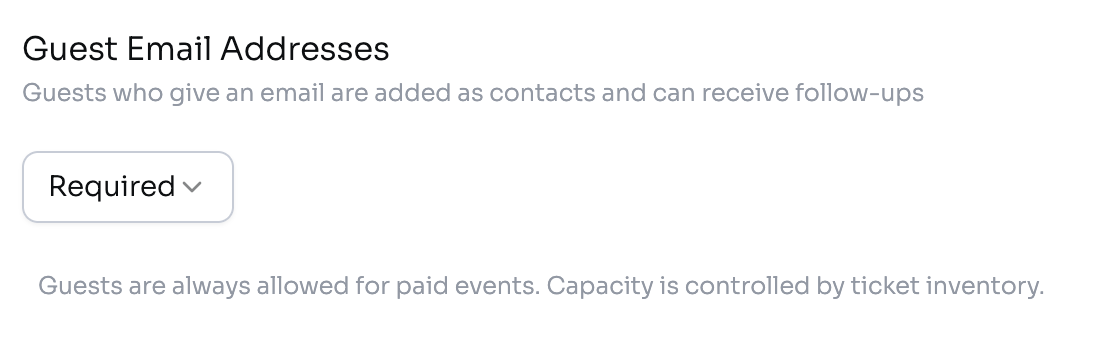
The Guest Email Addresses setting controls whether the registration form asks for an email address for each guest. Guests who give an email are added as contacts and can receive follow-ups. Choose Don't ask, Optional, or Required from the drop-down. On a free event, the setting appears under Allow Guests. On a paid event, it appears next to Require Guest Names. If you don't change it, paid ticket forms use Optional and free events don't ask for guest emails.
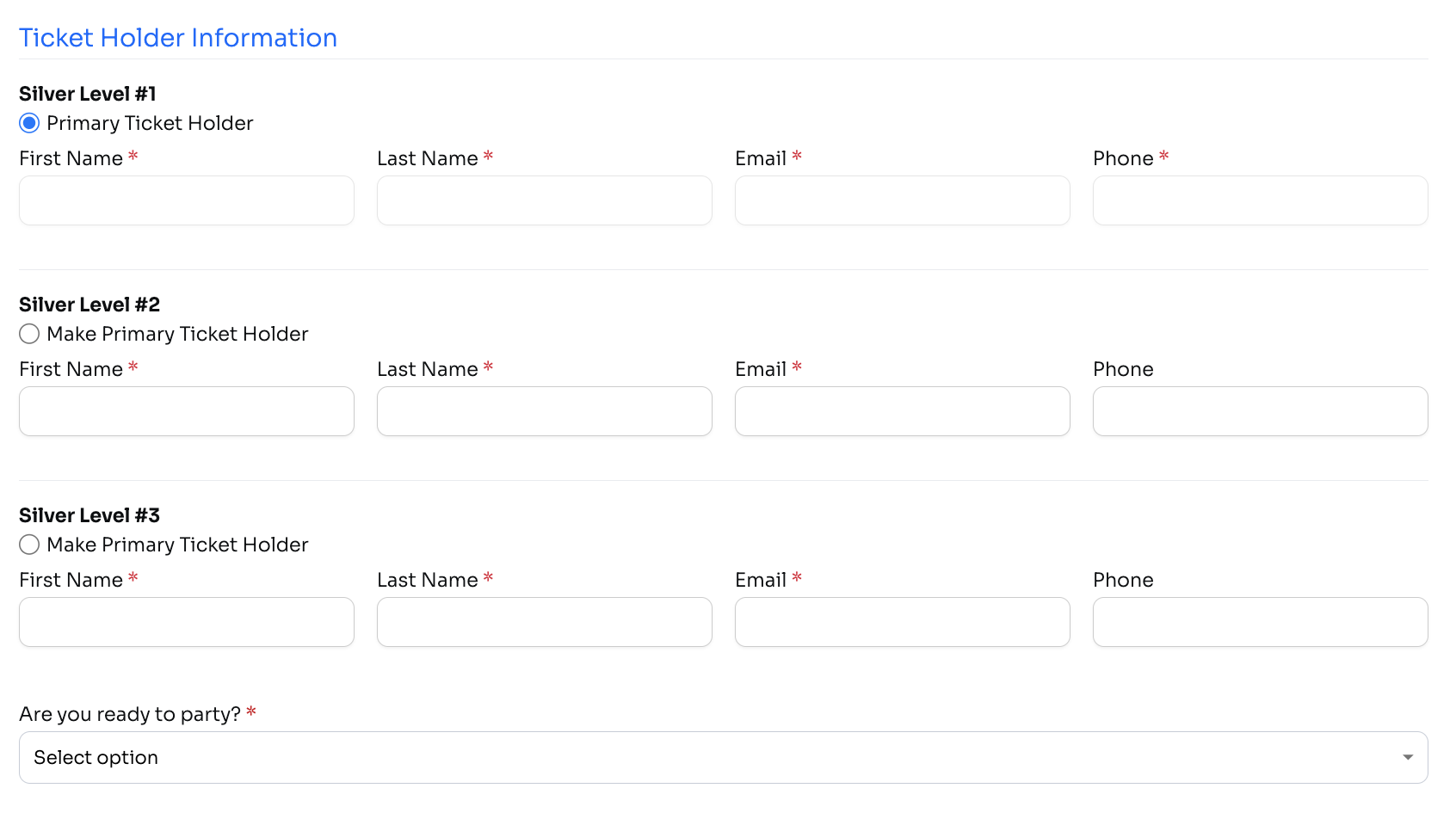
When the event asks for guest emails, each guest row on the public registration form includes an email field. A guest who gives only an email address is kept as a guest.
Guest contacts and tags
A guest who gives an email address becomes a contact. Levitate matches the address to an existing contact, or creates a new contact owned by the event's creator. Guest contacts get guest-only tags:
- Event Guest: followed by the event name, while the guest is attending.
- Event Guest Check-In: followed by the event name, when the guest is checked in on their own.
The tags are removed when a guest is removed from the registration or the registration changes to not attending.
Follow-up emails
When the event has guest contacts, the Send Follow Up composer shows an Include guests of selected recipients checkbox. The checkbox is disabled until you choose a recipient status. Recipient counts include guest contacts.
Automations
On event registration automations, the Email, Add tag, and Remove tag steps have these options for guests:
- CC event guests on Email steps.
- Also tag event guests on Add tag steps.
- Also remove from event guests on Remove tag steps.
New event email steps start with the option off. Guest addresses that have bounced, unsubscribed, or are invalid are dropped from the CC. Survey links in emails that copy guests are generic, not specific to one recipient.
Reporting and manual registration
The event report lists each guest with their email address. The Register Attendee window checks that guest emails are in a valid format. Guest emails entered when you register an attendee are kept even if the event doesn't ask for guest emails, and the Required rule doesn't apply there.
Limits
- A registration can include up to 50 guest email addresses.
- On paid events, unpaid seats are not tagged and are not included in follow-ups.
- On paid events, guest contacts are created when the registration is saved, before payment.
- Guests don't receive confirmation emails or texts of their own.
- Registrations made before the setting was available are not updated with guest contacts or tags.
Confirmation Email Sender
Under the Include Check-In QR Code toggle in the event's Attendees settings, the Confirmation Email Sender setting controls who the registration confirmation email comes from. It has two choices:
- Levitate (no-reply): the default. The confirmation email is sent from Levitate's no-reply address.
- A team member: the confirmation email is sent from a team member's connected email account.
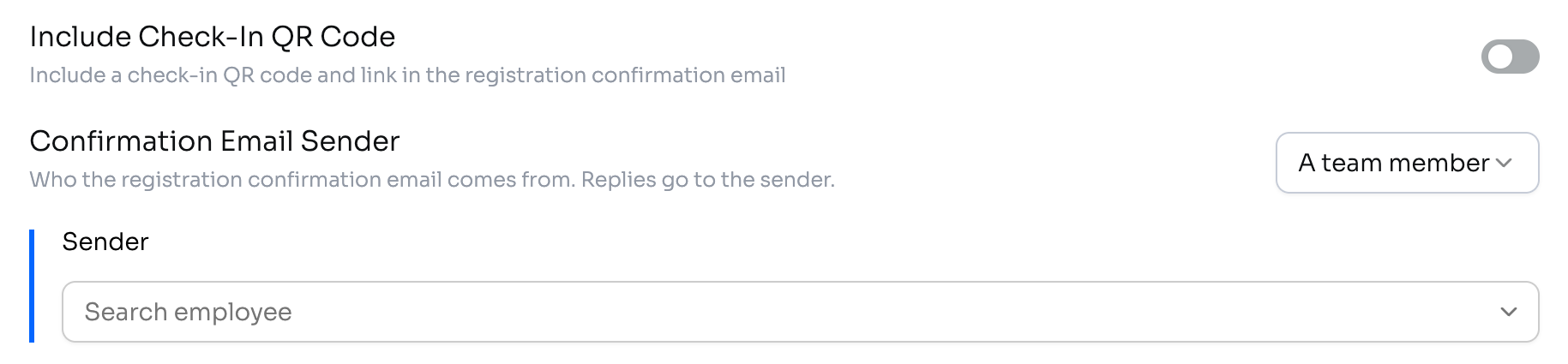
When you choose A team member, a Sender field appears. If your account has send-on-behalf enabled and you are an admin, click the field and search for a team member by name (the field reads "Search employee"). Other users see You followed by their own name, and the email is sent from their own connected email account.
The confirmation email is sent from the chosen person's connected mailbox and includes the calendar file (.ics) as an attachment. In Outlook, the calendar file appears as a regular attachment.
The Sender field starts out set to the person who created the event. On a copied event, it starts out set to the person who copied it.
Shared mailboxes
When the confirmation email is sent as a team member who has a default shared mailbox, it goes out from that shared mailbox, the same as other emails sent from a user. This applies to Gmail and SMTP/IMAP connections as well. If the team member has no shared mailbox, or has several, the email is sent from their own address. If their email account is not connected, or the send fails, the email is sent from Levitate's no-reply address.
Copied events
When you copy an event, the copy keeps the original event's sender only if you could have chosen that person yourself.
Check-in QR code
When the confirmation email is sent from a team member and Include Check-In QR Code is on, the email links to the check-in QR code instead of showing the code inside the message.
If the mailbox needs attention
If the chosen person's mailbox is not connected, or needs to be reconnected, a warning appears in the setting. In that case the confirmation email is sent from Levitate instead, with the chosen person set as the Reply-To address so replies still reach them.
Tracking and sent-email history
Note: Confirmation emails sent from a team member's mailbox have no open or click tracking, and they do not appear in Levitate's sent-email timeline.
RSVP Default Selection
The RSVP question on the registration form starts pre-selected on Yes for any respondent who hasn't recorded an answer yet — this applies whether they're opening the event using the Event URL or from their emailed invitation. Because Yes is already selected, ticket and sponsorship options (when the event has them) are visible right away, without the respondent needing to select Yes first. Respondents can switch their answer to No, which hides the ticket and guest fields again. A respondent's previously recorded answer, whether Yes or No, is always shown as-is and is never overridden by this default.
Note: This default doesn't apply to an event that's closed for registration. Once an event is past its Registration Deadline or at capacity, the form shows only the closed or full message, with no RSVP selector or ticket options.
If you want to add more questions for your invitees to answer, navigate to the Questions tab. From there, you can add additional questions in the form of a short answer, a dropdown pick list, and a list of checkboxes. Here's what the set-up looks like:

And this is what these custom questions look like on the form that the recipient will fill out:

Duplicating a Question
To reuse a question you've already built, open the question's three-dot menu and choose Duplicate Question. The option sits above Delete Question.
The copy appears directly below the original with the same text, question type, answer options, and required setting. It also keeps the original's "only show when" rule. The copy shows as unsaved, like a newly added question, so save your changes to keep it. Once saved, the copy and its answer options are independent of the original, so you can edit either one without affecting the other.
Question Visibility Conditions
You can configure additional questions in your Event Registration survey to appear or stay hidden based on how a respondent answers a prior dropdown or checkbox question. This lets you show follow-up questions only when they are relevant — for example, showing a dietary preference question only to respondents who select "Attending in person."
Setting up a visibility condition:
- In the Questions tab, add a dropdown or checkbox question. This will serve as the trigger question.
- Add the follow-up question you want to conditionally show.
- On the follow-up question, open its settings and choose to add a visibility condition. Select the trigger question and the specific answer that should cause this question to appear.
- Save your changes. The follow-up question will now only display when the selected condition is met.

What respondents see: Questions with visibility conditions are hidden by default. When a respondent selects the answer that triggers a condition, the associated question appears automatically. If a hidden question was marked as required, it is automatically treated as optional while hidden so the form can still be submitted without it.
Reordering questions with visibility conditions: When you reorder questions, the survey enforces dependency rules. If you move a question before its trigger question, the visibility condition on that question is removed. Review your conditions after reordering to make sure they still reflect your intended logic.
Sharing an Event with a QR Code
To generate, copy, and save a QR Code for an Event you'll go to Surveys, and go to the Events tab. From there, you'll see that each Event has a button that says QR Code. When you click that button, a pop-up with the QR Code to copy or download will appear. QR Codes are good for sharing on print media and on social media. We recommend using the Event URL for improved tracking when sending through email.
What the event looks like:

What the QR Code pop-up will look like:

Checking In Attendees
Unique to our Event Registration survey is the ability to check-in attendees on the day of the event. There are two ways that check-in works.
Through Event Registration Reporting:
- Access Event Registration Reporting by choosing Reporting from the menu item on the lefthand navigation menu, then Event Reports. From there, you'll choose the individual event.
- Starting on the day of the event, a Check In checkbox appears beside each attending registration when the Attending count is selected (the default view). The checkbox doesn't appear on the Not Attending or No Response views.
- As attendees arrive to the event, check off names using your laptop or tablet.
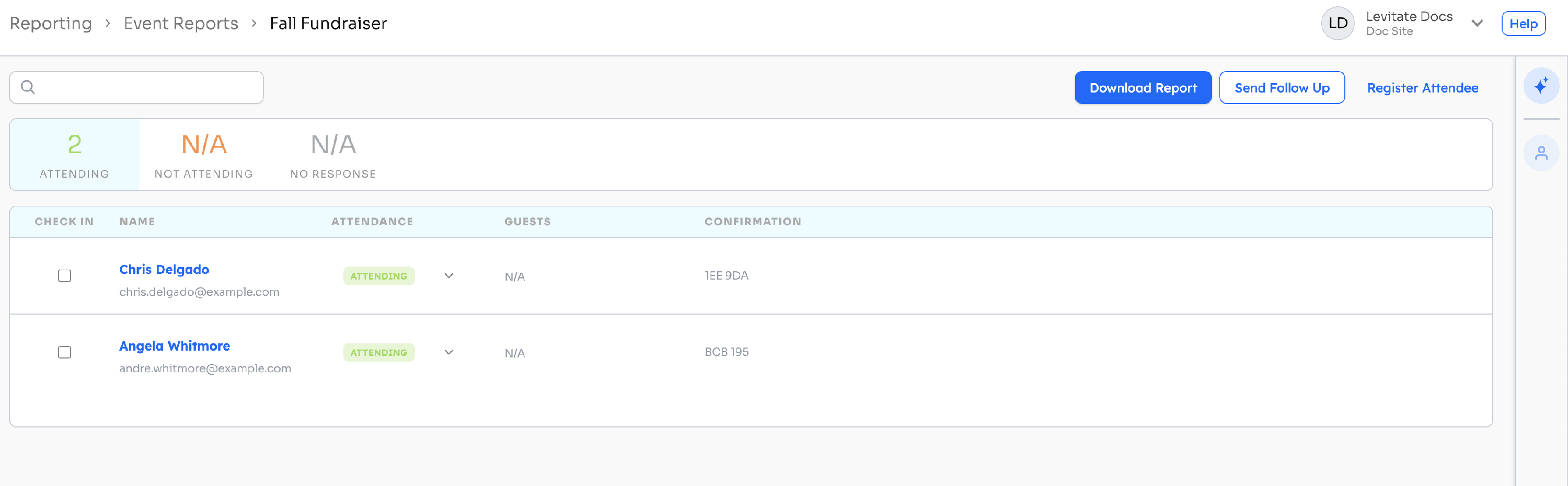
Note: There is one checkbox per registration, for the person who RSVPed. Guests (plus-ones) on that registration don't get their own checkbox.
Through confirmation QR Code
- When a contact RSVPs as Attending, they'll receive a confirmation email address with a unique QR Code.
- When attendees arrive to the event, a Levitate user can scan these QR Codes when presented using their mobile phones. Most mobile phones support the ability to recognize and scan QR Codes using their cameras.
- Once a QR Code has been scanned, the attendee will be checked in.
Note: The QR code in the confirmation email is optional. In the event's Attendees settings, turn off Include Check-In QR Code to remove both the QR code and the check-in link from the confirmation email that attendees receive after RSVPing Attending. The toggle is on by default, so leaving it on keeps the confirmation email as-is. Turning it off doesn't change the confirmation number or whether the confirmation email is sent — attendees can still be checked in through Event Registration Reporting.
Keeping track of responses
Just like any of our other surveys, you can check in on your RSVPs via our Event Report page, which you can access through Reporting. You'll be able to see who's responded (yes or no) and who hasn't– you'll also be able to export this data as a spreadsheet. You can view reporting in a list or grid view, as shown below.


Each event will have its own line and full report. All answers, including answers to custom questions, will be recorded in the report. The report will also show which attendees have been checked in using the above methods.
Following up on Event Registration responses
Much like with group email campaigns, users will be able to send a follow-up email to recipients of an event invitation. Users can choose who to send the email to through segmentation by response type. Reports can also be downloaded for manual tagging and record keeping.


Creating an event registration automation
Users are able to create an automation triggered by an invitee responding 'I'm Attending.' Just like other automations, an email or text message can be sent, a handwritten card, an action item can be assigned, and more.
If the invitee changes their RSVP response, the automation can be set to automatically stop.
Read more about Event Registration automations here.
Event Reporting in Levitate
Accessing Event Reports
- Log in to your Levitate account.
- Navigate to the Reporting section from the left-hand menu.
- Click on Event Reports.
- Select the event you would like to review from the list.

Viewing Historical Event Reports
To view past events:
- Select Include Past Events (if available).

Event Metrics Available
Within each event report, you can view:
- Confirmed attendees
- Not Attending
- No Response
Exporting Event Reports
You can export event data for additional analysis or recordkeeping.
To export:
- Click on the specific event.
- Click Download Report

Event Report Layout
The event report header has two rows. The first row holds the search box and the action buttons. The second row is a bordered stat card with the Attending, Not Attending, and No Response counts. Click a count to filter the report to that group.

The action buttons are separate buttons in the header:
- Download Report: exports the event data to a spreadsheet.
- Send Follow Up: opens the email composer so you can follow up with recipients by response type.
- Register Attendee: registers an attendee for the event.
Anyone with access to Event Reports sees this layout. Paid events use the same header and buttons.
Viewing Event Reports on Tablets and Phones
The event report works on tablets and phones as well as on a computer.
- 768 pixels wide or narrower: the header wraps and the buttons move to their own row.
- 640 pixels wide or narrower: the header stacks vertically and the table turns into a list of response cards.
Each response card shows the attendee's name, an attendance badge, and a Check In checkbox. The checkbox appears once the event has started. Tap the badge to open the RSVP menu, where you can choose Attending or Not Attending, or choose Manage RSVP.
Tap View details on a card to open a drawer with that registration's guests, confirmation, and answers. On paid events, each card also shows payment status and amount, the drawer lists tickets and amounts, and the event total appears under the cards.
Scrolling the Response Table
When the table is wider than your screen, the header row and the Name column stay pinned as you scroll, so you can always see which attendee each row belongs to.
Managing Event Registration Dates
Keeping Registration Open Past the Event Date
Event registration in Levitate does not automatically close when your event starts. Registration is controlled by an optional Registration Deadline field in the event's Attendee Options — not by the event start date itself.
- If no deadline is set, registration stays open until the event is archived.
- If a deadline is set, registration closes at the end of that day (11:59 PM).

To keep registration open past the event date:
If you previously set a registration deadline and need to extend it:
- Open your event and go to Attendee Options.
- Find the Registration Deadline field.
- Either remove the deadline entirely or update it to a later date.
- Save your changes.
Tip: If you expect walk-ins or late registrations, leave the Registration Deadline field blank. Registration will remain open until you archive the event.
Event Reporting Troubleshooting
A Contact Shows "No Email" But Claims to Have Received the Invitation and RSVP'd
The "No email" label in event reporting means that, at the time the invitation was sent, the contact did not have an email address on their Levitate profile. This is recorded automatically and does not update retroactively.
If a contact appears under "No email" but says they received the invitation and RSVP'd, here are the most likely explanations:
1. They used a different email address The contact may have RSVP'd using an email address that differs from what's saved in their Levitate profile. Check the contact's profile for any additional or alternate email addresses.
2. They accessed the survey through a forwarded link If someone forwarded the invitation email, the recipient can submit the survey without being linked to the original contact record. The RSVP may exist, but it won't appear under the expected contact.
3. Email tracking was blocked Some email clients or browser settings block tracking pixels, which can prevent the system from recording a successful delivery — even if the contact did receive and open the email.
What to do:
- Open the contact's profile and review all email addresses on file.
- Check whether the invitation may have been forwarded to them.
- Confirm the RSVP response and compare the email address used against what's in their profile.
Note: The "No email" status reflects the contact's profile at the time of sending. Updating their email address after the fact will not change how they appear in existing event reports.
Sending a Follow-Up to Non-Respondents
If you want to resend an invitation or nudge contacts who have not yet responded to your event RSVP survey, you can send a targeted follow-up email directly from the event report.
- Navigate to Reporting from the left-hand menu and select the event you want to follow up on.
- In the report header, click the No Response stat to confirm the count of contacts who have not yet replied. This count represents known contacts only and does not include guests.
- Click Send Follow Up.
- In the email composer, select No response under "Select Recipients to Follow-Up" to target only the contacts who have not replied. You can also select other response groups (Attending, Not Attending) in the same step.
- Compose your follow-up message and send.
Note: The recipient count shown for each response segment reflects known contacts linked to Levitate profiles. Anonymous or guest registrations are not included in these counts.
FAQs
Q: Can I keep event registration open after the event start date?
A: Yes. Registration does not close based on the event start date. It only closes if you've set a Registration Deadline, and only once that deadline date has passed. To keep registration open, remove the deadline or set it to a future date.
Q: Why does a contact show "No email" in my event report if they say they RSVP'd?
A: "No email" means the contact had no email address in Levitate at the time the invitation was sent. If they RSVP'd, they may have used a different email address, accessed the survey through a forwarded link, or their email delivery wasn't tracked due to privacy settings. Check their contact profile for alternate addresses.
Q: Can I create an event RSVP survey without sending confirmation emails to registrants?
A: No. When a contact RSVPs as Attending, Levitate automatically sends them a confirmation email. By default, that email includes a unique QR code for check-in, though the event's Attendees settings include an Include Check-In QR Code toggle that can turn the QR code and check-in link off without affecting the confirmation email itself. There is no setting to disable the confirmation email on event registration surveys. If you need a survey for purely internal tracking purposes where respondents should not receive any automated messages, a Custom Survey may be a better fit — Custom Surveys include a setting to suppress the confirmation message sent to respondents.
Q: How do I resend the event invitation to people who haven't responded?
A: From the event report, click Send Follow Up. In the email composer, select No response as the recipient group to target only contacts who have not yet replied.
Q: A contact received the invitation email but does not appear in any RSVP category in the event report. Why?
A: There can be a short delay between when an invitation is sent and when the contact appears in the event dashboard. If the contact received the email but has not yet responded, they will appear under No Response rather than under Attending or Not Attending. Check all response categories in your event report, and allow some time for email delivery confirmation to be recorded. If the contact still does not appear after a reasonable wait, verify that the email address on their contact profile matches the address the invitation was sent to, and check whether the invitation may have been forwarded to them from another address.
Q: Why does my event date show an abbreviated month name like "Jun" instead of "June"?
A: Levitate currently displays event dates using an abbreviated month format in certain views — for example, "Jun 15, 2025" rather than "June 15, 2025." This is how the platform formats dates in those areas and is not something that can be adjusted in event settings. If a specific date presentation is important for your event, consider including the full date with the written-out month name in your event name or description. If you would like to see a full month name format supported, please share that feedback with our support team.
Q: How do I collect meal or dinner selections from each attendee, including their guests?
A: To collect meal preferences, go to the Questions tab when building or editing your event and add a Dropdown question (if each person picks one option, such as chicken, fish, or vegetarian) or a Checkbox question (if multiple selections are allowed). Label the question clearly — for example, "Dinner selection" — and add each meal option as a choice. Mark the question as required if you need every registrant to answer before submitting.
Each registrant answers the custom questions once when they fill out the RSVP form. If your event has plus-ones enabled, the registrant answers on behalf of themselves only — the guest fields collect the guest's name but do not repeat the custom questions for each guest. To collect a meal choice for each guest as well, add a separate question for that purpose, such as "Guest dinner selection," and include the same set of options. If you allow more than one plus-one, consider adding a numbered question per guest slot (for example, "Guest 1 dinner selection," "Guest 2 dinner selection") so you capture a response for each person attending.
Note: Custom question responses are recorded per registrant in the event report. When you download the report, each row represents one registration, and the answers to custom questions — including any guest meal selections you added as separate questions — appear in the corresponding columns for that row.
Q: I'm trying to manually register a contact for an event and keep getting an "already registered" error, but the contact does not appear on the registrant list. Why?
A: This happens when the contact has a previous registration record on file for this event — for example, if they registered earlier and were later removed from the attendee list. Removing a contact from the registrant view does not fully clear the underlying record, so the system still sees them as registered and blocks a new entry. To resolve this, please contact Levitate support and we can clear the existing record so the contact can be registered again.