
Donation Boards
In order to allow for our Non-Profit, donation collecting, accounts to import and view their donation data in a much more powerful way, we're introducing Donation Boards!
Adding donors, donations, and more
Uploading via Spreadsheet
Just like uploading contacts via our contacts page, users can import donors and their donation details from a spreadsheet! There are a few fields that can be used specifically for donor identification and organization: Donor Name, Date (of donation), Amount (donated), Primary Email (to tie donation back to the contact in Levitate), Donation Details (contextual information on the donation) and Campaign (which most donation-based organizations use to sort out different efforts!).
Since some donations come from other organizations or groups, Levitate supports imports of donors without last names.
Fields required for the spreadsheet to upload successfully are Donor Name, Amount, and Date. Primary Email is not a required field for spreadsheet upload.
To import from a spreadsheet, you'll choose the dropdown arrow beside 'Add Donation' and, from there, you'll be prompted to import your spreadsheet. You'll need the spreadsheet saved as CSV for best results.
Donation Details can be added through spreadsheet import or through manual entry.
In the dropdown under 'Add Donation', you can choose 'Import from CSV' to add donations in bulk.
Note: Add Donation, Import from CSV, and Delete previous import are hidden on accounts with a donor-management integration, where donations sync in and can't be edited in Levitate. See Board Header and View Only Mode.

Format and example for importing donor information via CSV upload:
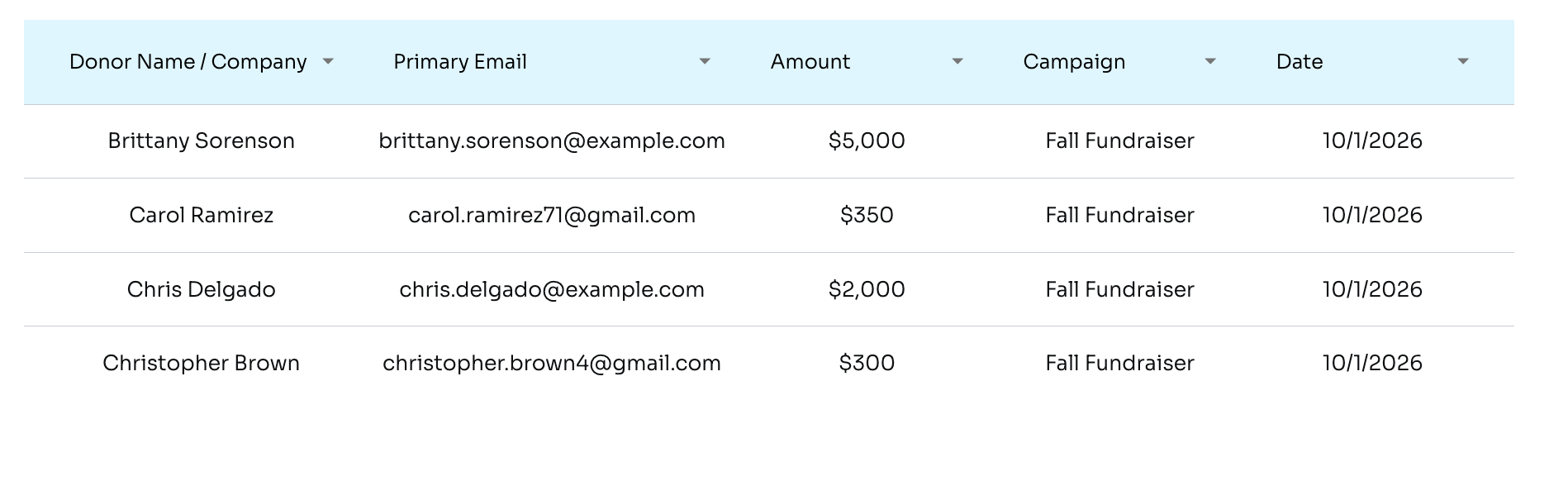
The Details column is also supported in CSV imports. In your spreadsheet, add a column with the header Details (also accepted as Notes or Memo) and enter any contextual text about the donation in that column. The sample CSV you can download from the import screen includes this column.
Import row warnings
When a CSV import contains rows where the email address matches more than one contact, the Process step now lists each affected row individually — showing the row number and a description of the issue — instead of displaying only a total warning count. This makes it straightforward to locate and correct the problem rows before completing the import.
Matching by Additional Id or Levitate Contact Id
CSV imports now support two additional identifier columns for matching donations to contacts: Additional Id and Levitate Contact Id. When either column is included in your spreadsheet, the import uses that identifier to resolve cases where an email address belongs to more than one contact. Rows that would otherwise be flagged due to a duplicate-email match can now complete successfully when a tie-breaking identifier is present.
Adding one at a time
Only have one donation to add? Don't want to add through spreadsheet import?
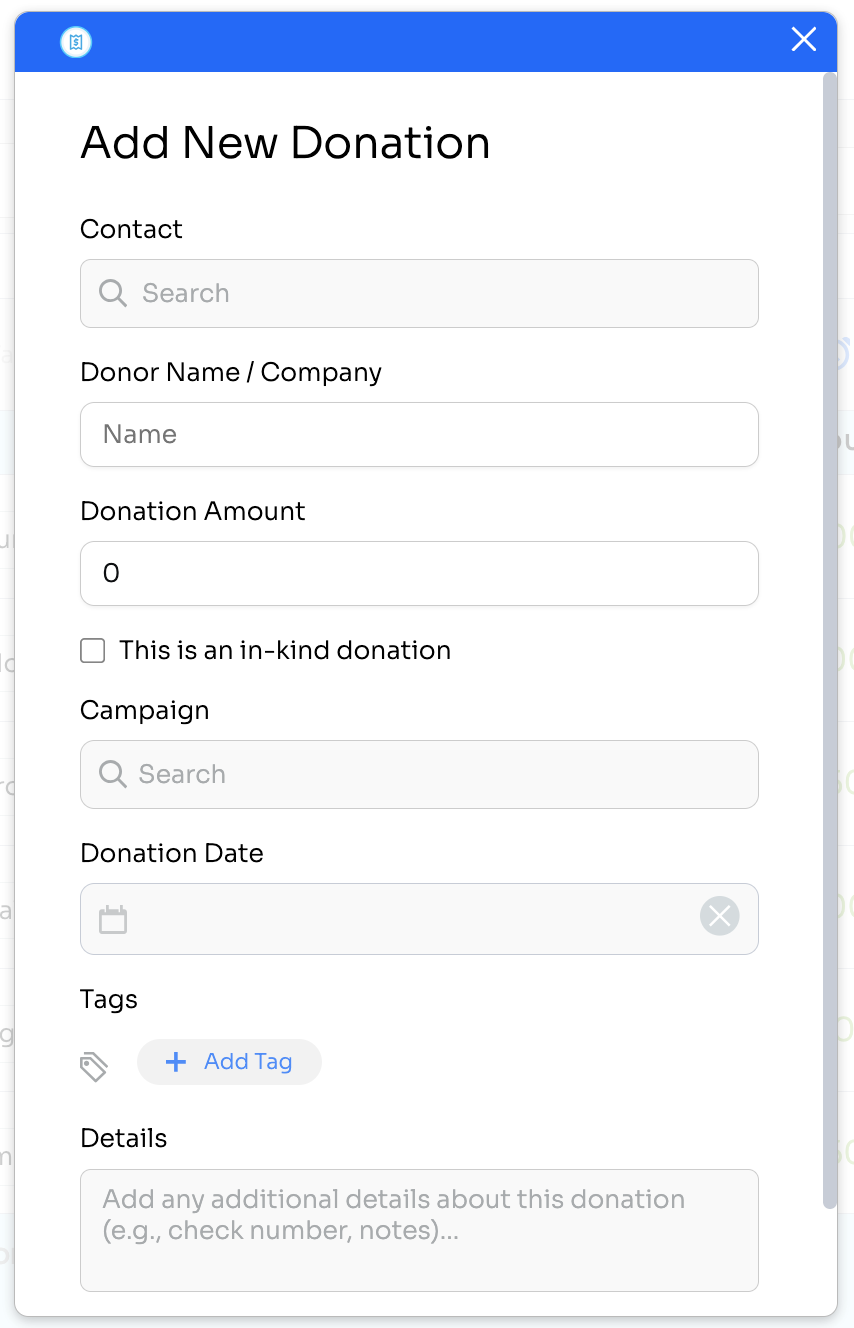
Click 'Add Donation' on the right side of the Donation Board and you'll be prompted to enter information here...
In-Kind Donations
Want to log donations that don't carry a dollar amount? Use In-Kind Donations with the Levitate Donation Board.
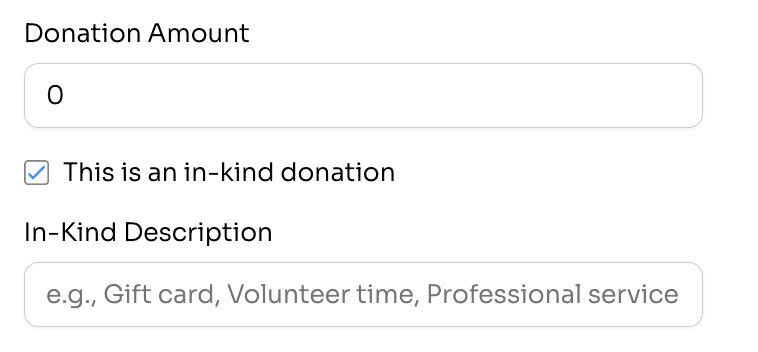
When creating a new donation, the donation amount can be set as zero, the checkbox for 'This is an in-kind donation' can be checked, and a description of the In-Kind donation can be manually typed in. Here's what that looks like:
In-Kind Donations are also supported through CSV import. Three fields can define an In-Kind Donation— the Amount will be $0, a column with the header 'Is In-Kind Donation' will say 'yes' for that $0 donation, and a description can be added in its own column with the header 'In-Kind Description.'
Here's how an import can be formatted:

And this is what it'll look like on the Donation Board:

Anonymous Donations
To log a donation without tying it to one of your real contacts, use Anonymous Donor as the donor name — whether you're adding the donation one at a time or importing via spreadsheet.
When you import a spreadsheet, Levitate treats "Anonymous Donor" like any other donor name: if a contact with that exact name doesn't already exist, it's created automatically; if it does exist, the new donation is added to that same contact. This means every anonymous donation rolls up under one shared "Anonymous Donor" contact, so they're still trackable and reportable as a group.
- Adding one at a time: Click Add Donation and select your Anonymous Donor contact in the Contact field. A donation can't be saved without a contact, so if that contact doesn't exist yet, create it first.
- Importing via spreadsheet: Enter Anonymous Donor in the Donor Name column for any rows you want logged anonymously.
Note: This is for donations you're logging on a donor's behalf. If you're collecting gifts directly from donors online instead, Donation Surveys have their own built-in Anonymous Donations option that lets a donor keep their own gift anonymous when submitting the survey.
Sorting your donors, donations, and donor data
There are many ways to sort donation data with our Donor Boards!
Filtering by Campaigns or Donors
First and foremost, you're able to sort by Campaign or by Donor. This way, you're able to get granular information by individual contributor or by individual campaign.

Filter by a campaign:
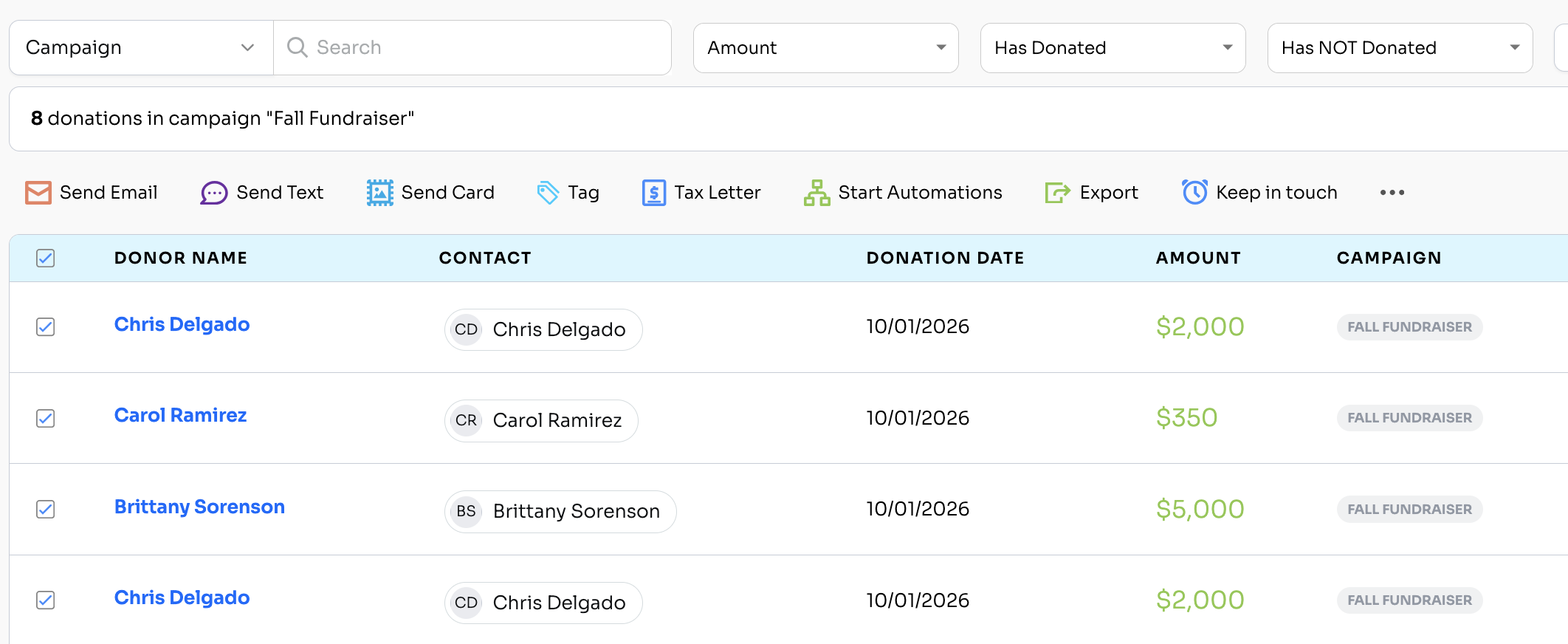
See each donation for this campaign.
Filter by a donor:
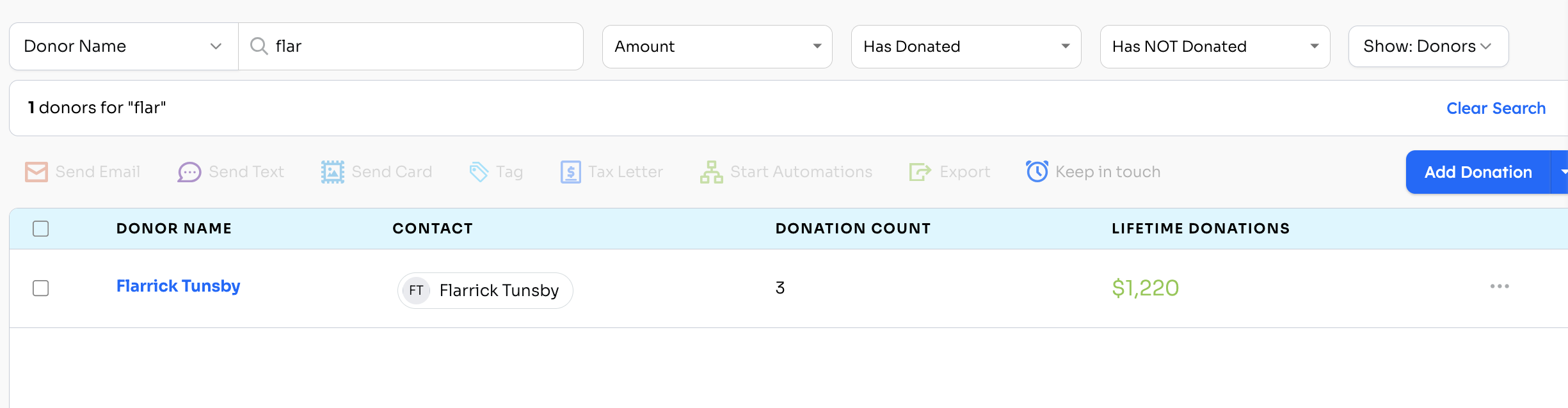
See an aggregate of donations for a donor.
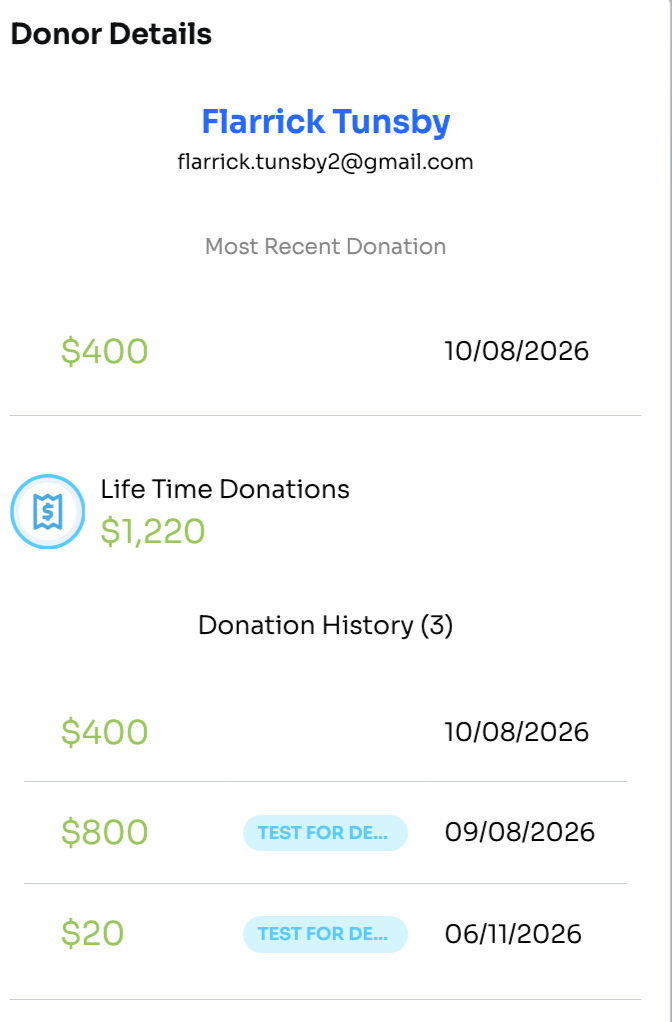
Also, if you want to take a closer look at that donor's history, click into the 'Donor Name' and check out their most recent donations, lifetime donations, and more.
Lapsed Donor Filtering
Lapsed Donor Filtering is essentially date range support for "Has NOT Donated" and "Has Donated" allowing users to see when donors have and have not donated, both filters can be applied as well.
As an example, both filters can be applied to see if a donor might've given last year but not this year for better targeted outreach.

Filter by amount
You're also able to sort by amount, in a few ways. Users are able to filter by an aggregate, lifetime, amount of donations, or just by each individual donation. So, for Lifetime, if you gave $500 each year for three years, you'd see $1500, but for One-Time you'd just see three separate donations of $500. With this filter, you are also able to set minimums and maximums for enhanced targeting.

Filter by cadence of donations
Other criteria that can be used to filter is their donation cadence– users are able to sort by if the donor has or hasn't donated within a certain time frame, using the Has Donated and Has NOT Donated dropdowns. Available time frames are 1 month, 3 months, 6 months, 1 year, 3 years, This Year, Last Year, and Custom Range.

Finally, just like with our advanced contact search, multiple filters– listed above– can be used to narrow down one search for donors or donation data.
Reaching out through the Donations Board
Just like the outreach options on our Contacts view, users are able to select multiple donors and create emails, text messages, handwritten cards, and automations. Users are also able to export donor data through the Donations Board. This data will be exported as a CSV spreadsheet.
Note: The automation, handwritten card, and text message options appear only when those features are enabled for your account and available to your user.
Bulk Delete
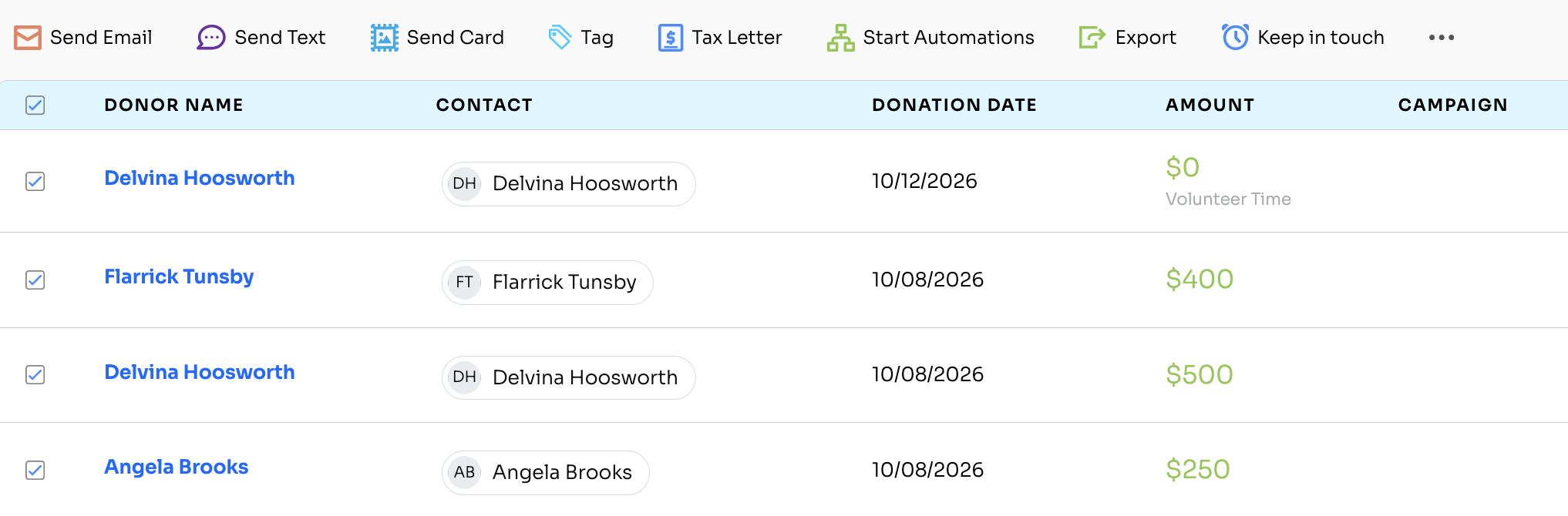
You can now select multiple donations and delete them in bulk directly from the Donation Board. Select the donations you want to remove using the checkboxes, then choose Delete from the bulk action toolbar.
Note: Bulk Delete is available only when the board is set to show Donations, not Donors, and is hidden on accounts with a donor-management integration.
Date-Based Search
The Donation Board now supports searching and filtering by date, making it easier to find donations within a specific time period. Use the date filter to narrow results to a particular range.
Delete Previous Import
If you imported donations from a CSV and need to undo the entire import — for example, after spotting an error in the source file — you can revert it from the Donation Board. Click the arrow next to the Add Donation button and choose Delete previous import to remove the donations from the most recent import in one action.

Note: Delete previous import only removes donations created by the most recent CSV import. Donations added individually or from earlier imports are not affected.
Donation Merge Fields
Two merge fields are available in the Merge Fields dropdown under a Donations section:
{{last donation amount}}— resolves to the donor's most recent donation amount.{{last donation date}}— resolves to the date of the donor's most recent donation.
These fields can be used in email templates, automations, and any other context where merge fields are supported. If a contact has no donations on record, the field resolves to blank.
Donations + Automations
New Donor Automations
Yes! If you are pulling donations into Levitate, through Donor Perfect, a connected Zap, or even just manually or through spreadsheets, an automation can be kicked off when a New Donor is added to Levitate.
This automation can be used to thank new donors, send a series of welcome emails or tax documents, and much more to drive donor engagement.
The donation will have had to be the first donation received from the contact and received and/or dated in the past 24-hours for the contact to qualify as a 'new donor,' so when an account is onboarding with all of their donation data, contacts with existing donations won't all be filtered to the automation.
New Donation Automations
Yes! If you are pulling donations into the Levitate Donation Board, an automation can be kicked off when a New Donation is logged. Unlike the New Donor automation, the New Donation automation picks up regardless if the contact has donated in the past or not.
The donation will have to be received and/or dated in the past fourteen days to be considered a New Donation in Levitate, so when an account is onboarding with all of their donation data, contacts with existing donations won't all be filtered to the automation.
Board Header and View Only Mode
The Donation Board header collapses responsively at narrower screen widths — all filters and controls stack vertically so the board remains fully functional regardless of viewport size.
If your account has a donor-management integration (DonorPerfect or Bloomerang), a persistent View Only Mode badge appears at the top of the board for everyone on the account. Donations sync from your donor management system, so they can't be edited in Levitate: Add Donation, Import from CSV, Delete previous import, and bulk Delete are hidden. The badge is always visible — it does not dismiss on its own.
Household Donation Roll-Up
When a contact belongs to a household, the Data Boards tab on their contact profile shows a combined donation total for the entire household — the sum of all donations linked to every member of that household. This gives you the household's giving picture at a glance without needing to add up individual totals manually.
The roll-up lists each household member by name along with a combined household total, largest gift, and gift count. Individual member totals and the household summary are all visible on the same tab.
Donation History on Company Profiles
Company profiles include a Data Boards tab (previously labeled "Opportunities") that shows a rolled-up view of all donations linked to contacts at that company. Each linked contact's giving history is aggregated so you can see the company's full donation picture in one place without switching to the main Donation Board.
Note: The Data Boards tab on company profiles is only visible on accounts with the Donation Board or Opportunity Board feature enabled.
Viewing the company donation roll-up
Open any company profile and select the Data Boards tab. The tab lists each linked contact's donation total and displays a combined total rolled up across all contacts at that company.
If the company has more linked contacts than the system can include in the roll-up, the combined total is suppressed and a notice appears in its place. To calculate the full total in that case, open the main Donation Board and filter by the individual contacts linked to that company.
Note: The company donation roll-up is retroactive — it includes donations from all linked contacts regardless of when they were entered. No re-import or data migration is required; existing donation data is reflected automatically.
Adding a donation from the company view
You can add a new donation directly from a company profile without navigating to the main Donation Board. On the Data Boards tab, click Add Donation. The donor picker is scoped to contacts already linked to that company, so the donation is attributed to one of those contacts.
FAQs
Q: How do I run a donation report for my current fiscal year?
A: Use the Has Donated date filter on the Donation Board. Open the filter and choose This Year to see all donations from January 1 of the current calendar year through today, or choose Custom Range to enter any start and end dates that match your organization's fiscal year (for example, July 1 through June 30). Once the date range is applied, use the export button to download the filtered results as a CSV.
Q: How do I compare donations from this fiscal year versus last fiscal year?
A: Run two separate exports using the Has Donated filter. For the current year, select This Year (or use Custom Range to set your FY start and end dates). For the prior year, select Last Year (January 1 – December 31 of the previous calendar year) or use Custom Range to enter the prior year's FY dates. Export each result set as a CSV and compare them side by side.
Note: This Year and Last Year are based on the calendar year (January 1 – December 31). If your fiscal year runs on a different schedule, use Custom Range and enter your FY start and end dates manually.
Q: Why does a donor appear in the Donations Survey Report but not on the Donation Board?
A: The Donations Survey Report lists everyone who submitted your donation form, including people whose payment did not go through. The Donation Board only records a donation once its payment completes successfully. If a card is declined, the donor has insufficient funds, or the donor abandons the payment after submitting the form, the submission shows in the report but no donation is added to the board.
Q: Why don't payments for event registrations appear on the Donation Board?
A: Event registrations and donations are tracked separately. Payments made through an event registration form are recorded as paid registrations, not on the Donation Board. To see who has paid, go to Reporting → Event Report and open the paid event. See Event Registration: Paid Events for details. The Donation Board shows gifts made through your donation form, donations pulled in through Donor Perfect or a connected Zap, and donations you add or import yourself.